
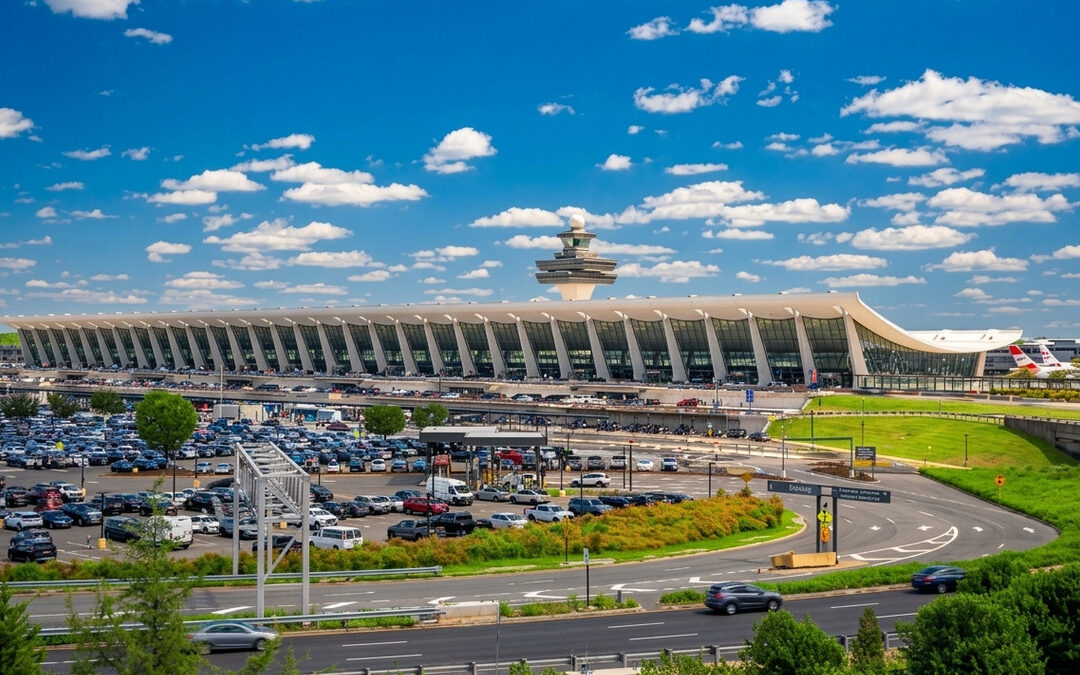
Air travelers flying through the D.C. area could soon see fewer delays as the Federal Aviation Administration (FAA) begins using a new artificial intelligence system to predict air traffic bottlenecks before they happen.
The FAA and the Department of Transportation (DOT) launched Strategic Management of Airspace, Routes, and Trajectories, known as SMART, in limited operations on Monday, September 21, initially rolling out the technology at three major airports serving the region.
Machine learning is already making U.S. airports safer and more efficient. Now, SMART will help identify potential disruptions earlier and help air traffic controllers manage congestion before it affects passengers.
New AI System Will Predict Air Traffic Bottlenecks Before They Happen

According to a press release by the FAA, thousands of scheduled flights face delays every day due to demand for airspace exceeding an airport’s capacity and unpredictable weather, forcing the FAA to reroute flights or shut down portions of airspace.
Rather than simply wait for delays to develop, the SMART system centralizes 200 data streams, including weather patterns, flight paths, traffic flow, and controller staffing metrics, into one platform. SMART’s AI-supported engine then processes this data to provide an overview of where planes are going, how much traffic the system can handle, and where congestion or weather could cause challenges.
In the FAA’s press release, U.S. Transportation Secretary Sean P. Duffy praised the new SMART system.
“Thanks to President Trump’s leadership, we are already making remarkable progress on building a brand new air traffic control system. But to really improve the flying experience for the American people, we needed to build a 21st century scheduling tool like SMART,” Duffy said.
Duffy continued, “By fundamentally reshaping how we manage our airspace and preventing problems before they happen, SMART will slash those frustrating delays, reduce stress on air traffic controllers, and lower travel prices. The Trump Administration is committed to making flying hassle-free and affordable again.”
Ultimately, the system informs the FAA of any potential problems before they arise, helping it to anticipate demand, weather, and airspace constraints, not only on the day but also weeks ahead of time, resulting in many benefits for flyers.
Key Benefits Of The SMART System
|
Benefit |
Explanation |
|
Fewer delays and cancellations |
Flyers will spend less time waiting on the ground, circulating above the arrival airport, or dealing with diversions. |
|
Optimized airspace |
Unlocks more capacity with more efficient routing around bad weather and congestion. |
|
More predictable operations |
Preventing disruptions before they happen will reduce stress on controllers and let them focus on their mission safety. |
|
Lower ticket prices |
When airlines waste less fuel, reduce staff overtime, and have more planes arrive on time, operating costs fall, resulting in cost savings for consumers. |
In a press conference on Monday, Duffy unveiled SMART along with FAA Administrator Bryan Bedford, in which he further outlined the system and its benefits.
During the conference, Duffy said that SMART is the system Americans have been asking for and that it will create a better flight experience by making the nation’s airspace more efficient.
Bedford demonstrated the technology, showing how the system shows weather shifts and allows the FAA to tweak flight paths and speeds so all flights can land without severe delays.
Reagan National, Dulles, And Baltimore/Washington Are The First Airports To Get SMART

The initial SMART rollout covers three major airports in and around Washington, D.C., giving the FAA an opportunity to test the technology in a particularly complex and busy section of the national airspace.
The three airports in question are Ronald Reagan Washington National Airport (DCA), Washington Dulles International Airport (IAD), and Baltimore/Washington International Thurgood Marshall Airport (BWI).
|
Airport |
Number Of Daily Flights (Arrivals and Departures) |
|
Ronald Reagan Washington National Airport |
Approximately 800+ |
|
Washington Dulles International Airport |
Approximately 850 |
|
Baltimore/Washington International Thurgood Marshall Airport |
Approximately 650+ |
All the airports operate numerous flights per day, making them the perfect places to test the new technology. The unpredictable weather and possibility of low clouds around the Washington, D.C. region also provide a useful test for SMART, as these conditions can create challenges for air traffic controllers.
WTOP News spoke to passengers at IAD, many of whom were optimistic about SMART.
“Anything that aids the air traffic controllers in helping them do their job and do it successfully is always beneficial,” he said. “And, if it helps us travelers not be delayed and not face cancellations or at least know a bit sooner, it’s all quite good,” one flyer at IAD told WTOP News.
Other passengers were more cautious, with one telling WTOP News, “A lot can be at stake if AI makes a simple mistake. Air traffic is very sensitive and very delicate, so any tool like that should be tested very, very well.”
While it is just the three airports that currently have SMART in place, as the FAA assesses its effectiveness, it is expected that the system will roll out across the country, replacing what Duffy called the “decades-old technology” already in use.
FAA’s AI System Will Support Air Traffic Controllers, Not Replace Them

While SMART relies on artificial intelligence to analyze large amounts of information and identify potential bottlenecks, the system is not intended to replace the people responsible for managing U.S. airspace. The FAA has been careful to stress that SMART is simply a tool designed to support air traffic controllers when making operational decisions.
“SMART cannot be used to replace the critical role air traffic controllers play or take over control of an aircraft. All of SMART’s recommendations are reviewed by FAA staff, and local leadership at air traffic control facilities can choose to accept or pass on these scheduling suggestions,” the FAA states in its press release.
If successful, the system could therefore simply improve how controllers work. By identifying potential congestion earlier, SMART aims to give aviation professionals more time to consider options such as changing routes or managing the flow of aircraft into busy airports.
Bryan Bedford also clarified in the press conference that SMART will not be used by controllers whose job it is to prevent collisions and maintain safety. However, there has been some pushback.
Virginia Democrat Rep. Don Beyer issued a statement calling for the FAA to suspend the system, stating that air traffic controllers were not involved in the development of SMART and not enough training has been given.
“The FAA should not use my constituents as guinea pigs for an unproven AI air traffic control system,” Beyer said in the statement.
Beyer went on to say that SMART should be suspended until it is clearly established beyond doubt that the technology is safe, and this has been proven by air traffic controller feedback and independently verified stress testing.
Despite the criticism, the CEOs of some of America’s largest carriers, including United Airlines, American Airlines, Delta Air Lines, and Southwest Airlines, have expressed their support, all stating they are planning on working closely with the FAA as the implementation of SMART begins.
TheTravel has reached out to the FAA for comment.

Recent Comments