
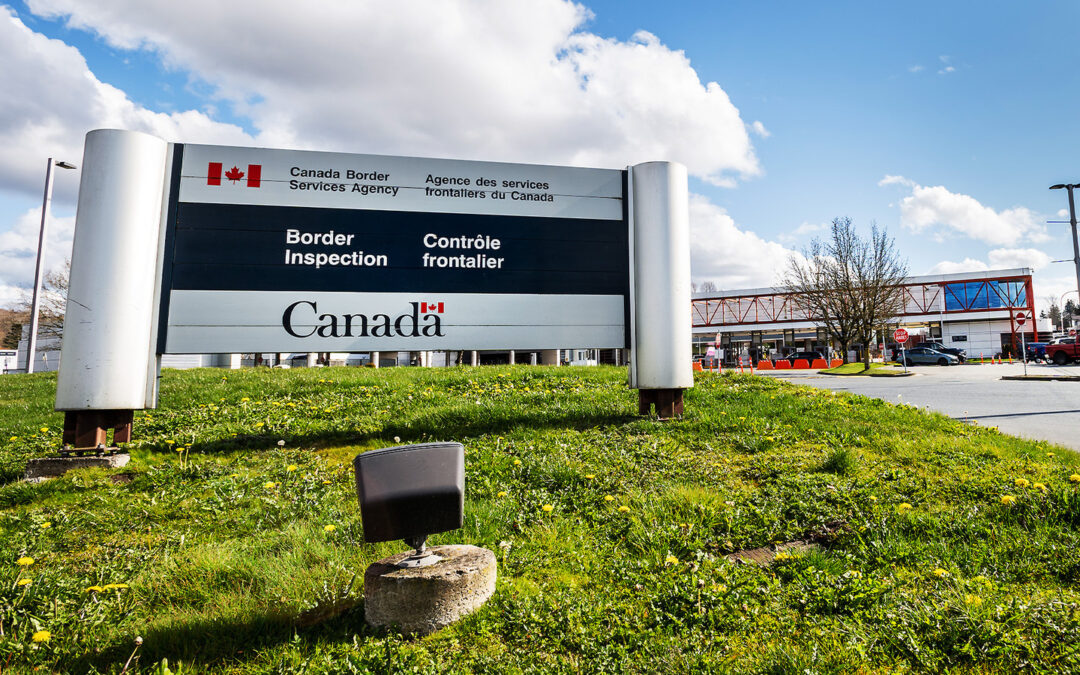
Both U.S. Customs and Border Protection (CBP) and the Canada Border Services Agency (CBSA) enforce the rules of the United States and Canada on all travelers crossing the border. The NEXUS program, operated by both agencies, carries heavier rules for privileged travelers, but even a tiny mistake (like using the wrong lane at a border crossing) can lead to a lengthy ban.
NEXUS allows pre-screened travelers to enter the U.S. or Canada much faster than everyone else via speedy processing lanes or kiosks. Obtaining membership is pricey at $120, so losing it over a simple error can be pretty frustrating — as was the case for one particular traveler who recently entered Canada from America. Their $10,000 cash oversight left them stripped of their NEXUS privileges in an instant.

The traveler in this story, who appears to be Canadian or at least a Canadian resident, says they made a regrettable mistake that ended up costing them their NEXUS privileges. Telling their account of events to Reddit, they explained that they brought $8,000 USD across the U.S.-Canada border, which is around $11,300 CAD.
By law, all travelers entering or leaving Canada must declare currency totaling $10,000 CAD or more (and it’s the same for leaving/entering the U.S., which requires declarations of $10,000 USD or more). The CBSA even warns of this requirement on its website’s NEXUS page: “When you travel using your NEXUS privileges, you must not: possess CAN$10,000 or more of currency and/or monetary instruments.”

However, the traveler didn’t declare it to the CBSA because they “thought it was $7,000.” So, in this case, their failure to declare the $11,500 CAD total they were carrying quickly got them in trouble with Canadian border officers.
“They found [8,000 USD] + 500 worth of Japanese and Korean money, totaling 11.5K CAD,” the traveler wrote.
The traveler said they realized their error and tried to declare the correct amount, but the damage was already done by that point. They said they were swiftly stripped of their NEXUS and paid “5%” of what can be assumed is a fine for misdeclaring their cash.
“I corrected myself before they opened my [suitcase], but [CBP] said it was too late,” they wrote. “I paid 5% […] but my Nexus card was gone.
The traveler showed some remorse for their misdeclaration and explained it was a genuine mistake. They said they were exhausted from multiple travel legs, which led to their innocent oversight.
Not [trying] to excuse but I [transferred] airplane 5 times and took a bus, I was very tired that day. It was all my mistake.”
The CBSA doesn’t permit tiredness as an excuse for violations, though. “Negligence, carelessness or lack of knowledge are not acceptable reasons for violating your agreement. That is why it is important that you understand and abide by all NEXUS conditions,” the agency warns.

Still, they asked other travelers whether they could get their NEXUS reinstated. “Is it a good idea to hire a lawyer for maybe 15k, or any chance I can appeal myself?” they inquired. But others had a very stern response; even though they made an honest mistake, NEXUS rules are quite unbendable, and their violation could spell a multi-year ban.
“You Can’t Be Trusted”: Other Travelers Gave A Reality Check

Many people replied to the traveler’s NEXUS conundrum, and most seemingly were not on their side. After they asked if it would be possible to appeal their NEXUS ban, the consensus was a resounding “no.”
“Nexus has a zero strike rule. You can’t get it back,” one person wrote.
Other travelers echoed the same sentiment, explaining that the person has proven themselves to be an “untrustworthy” traveler in the “Trusted Traveler Program.”
“Nexus is a trusted traveler program, you’ve proven you can’t be trusted,” one traveler responded. “There’s nothing a lawyer do here,” another wrote. “You broke the trust between you and the governments on a privilege program.”
Members of the public urged them to declare all their cash next time, even if they’re “not sure” of the amount. “You were close enough to the 10k mark, why risk it?” one person pointed out.
Although in this instance, the traveler’s violation means the decision is final, it doesn’t mean they can’t ever get their NEXUS status back. In fact, they may well be able to; the ban might only be temporary.
Getting NEXUS Back After Revocation

The overall reaction to this traveler’s monetary mishap is aligned with the strict rules for holding NEXUS status. U.S. and Canadian governments emphasize the likelihood of revocation for even the smallest violation.
“If you fail to comply with all terms and conditions of the NEXUS program, your membership may be cancelled. You could lose your membership in the program if an inspection shows that you have violated NEXUS terms and conditions,” the CBSA warns.
Appealing a revocation is possible by submitting a request for review to CBP or the CBSA. The timeline to do so is limited to within 90 days of the NEXUS cancellation. However, chances are that this traveler’s case would be refused, since they’re now deemed an “untrustworthy” traveler by both governments.
Travelers can still reapply for a new NEXUS membership after their ban period is over, though the wait time depends on the violation. In this traveler’s case, their infraction appears to fall under “Bringing currency equal to or greater than $10,000 CAN into or out of Canada, unless exempt.” Therefore, their wait time to reapply would be between one and seven years, per the CBSA.
|
NEXUS Ban Wait Time |
Violation Type |
|---|---|
|
1 year |
Minor mistakes in documents or declarations |
|
2 years |
Helping non-members cross or transferring cards |
|
1–7 years |
Customs seizures, currency infractions, or prohibited goods |
|
10 years |
Criminal or immigration violations |
|
Permanent |
Serious offenses such as human smuggling, weapons, or narcotics convictions |
TheTravel has contacted the CBSA to clarify whether an appeal is possible, and to ask the precise number of years one must wait after overstepping currency rules. While the rules do permit reapplication following the designated wait time, the program is especially unforgiving if travelers end up with more than one violation. The CBSA warns that “multiple contraventions of program legislation or violations of the NEXUS terms and conditions” will brand a traveler ineligible for the longest period of time, which is ten years currently.
A second NEXUS cancellation and reapplication attempt could also lead to longer wait times, and applicants might even have to provide fingerprints and undergo a criminal record check, the agency says.

Overall, this traveler’s story is a lesson for all Trusted Traveler Program members (including Global Entry users) who cross the U.S.-Canada border from either side. Running afoul of NEXUS rules, even if accidental and entirely unintentional, could result in a multi-year-long ban from the program.
And given that membership costs $120 (which was only $50 before October 2024, according to CBP), such unintended errors are expensive. As the CBSA website states, that’s a “non-refundable application processing fee,” so once it’s gone, it’s gone. There are no refunds for revocations.
To avoid the same fate as this traveler, everyone crossing between the U.S. and Canada who intends to keep their NEXUS privileges intact must always count and declare their currency every time.

Recent Comments