
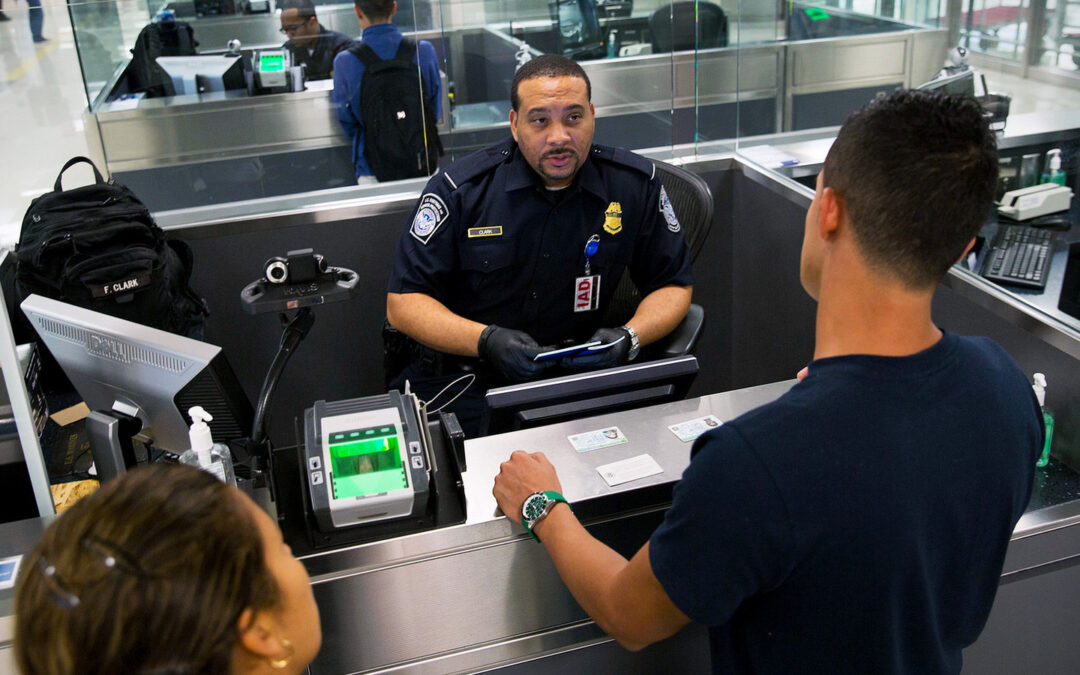
U.S. Customs and Border Protection (CBP) detained an American citizen at Miami International Airport (MIA) and questioned him over his book selection. Immigration advocate Thomas Kennedy shared his experience on Instagram and in the Miami New Times.
Kennedy said he was interrogated for hours after his long-haul flight back to the U.S. from a trip to Turkey and Egypt. This incident is the latest example of the agency detaining a citizen for a secondary inspection without referring them for criminal charges.
Earlier this month, an American attorney said CBP pulled him into a secondary inspection and revoked his and his wife’s Global Entry memberships after he declined to give officers his device passwords. In the Miami Airport incident, Kennedy also had his phone temporarily confiscated.
CBP Interrogates U.S. Traveler Over His Books At Miami International Airport

Kennedy said he arrived at MIA after a 15-hour flight, following his 10-day trip to Turkey and Egypt. While passing through customs, the agency’s biometric scanners flagged him.
Officers then took him for a secondary inspection and questioned him for nearly two hours, during which two officers did the “good cop, bad cop routine,” according to Kennedy.
In a video shared on Instagram immediately after the inspection, Kennedy described the interrogation.
“They asked about the literature that I had with me, asking why I had several history books that I took on the trip,” Kennedy said.
In his Miami New Times piece, he explained that he had books about “the Israeli occupation of Palestine and the Iranian revolution,” along with Egyptian magazines he had acquired during his tourism trip.
Kennedy recounted what questions officers asked him.
“Why did I have a book about Iran? What was it about? What were the Egyptian magazines about?” he recalled.
He refused to answer the “intrusive questions,” while reaffirming that he’s a naturalized U.S. citizen. Officers discovered the books while searching his bag and temporarily confiscated them along with his phone.
CBP Threatened To Confiscate His Phone Indefinitely
Kennedy at first tried to refuse a phone search, but officers said that could mean his device would be taken for an unknown amount of time.
“Initially, I resisted, but they threatened me with ceasing my phone indefinitely, so they did take it for a brief period of time,” he said in the social media video.
He added that he plans to scrub his phone after concerns about surveillance following the device search.
“They probably are surveilling everything on my phone right now, but that’s the reality of our country,” he said. “You can’t go on a trip without coming back and your political opinions being questioned, what you read, what you do for a living.”
He added that officers never gave him a concrete reason for his detainment, instead telling him that he could be detained “arbitrarily.”
After the fact, he learned that Florida State Representative Anna Eskamani attempted to call to check on his well-being; however, “she was hung up on four times, and CBP also refused to tell her” the reason for his detainment, Kennedy wrote.
He said that most of the detained travelers appeared to be of Middle Eastern origin, pointing to racial profiling.
“Most of the people were Middle Eastern, clearly being racially profiled indiscriminately, but that’s the reality of our country,” he said.
As for Kennedy’s concerns over CBP wiretapping his phone, the agency does not say it does this to travelers’ devices. However, the agency expanded its authority earlier this year on which devices it can search.
How CBP Can Search Travelers’ Devices

In early 2026, CBP updated its policy to allow officers to search more traveler devices, including: flash drives, SIM cards, GPS, drones, smartwatches, and vehicle infotainment systems.
CBP states that when officers search a device, they turn off its internet connectivity, so they cannot access cloud data.
“Prior to beginning a basic or advanced search, CBP Officers will ensure all data and network connections are disabled. To avoid retrieving or accessing information stored remotely and not otherwise present on the device, CBP Officers will either request that the traveler disable connectivity to any network (e.g., by placing the device in airplane mode, disabling Bluetooth and disabling Wi-Fi), or the CBP Officer will themselves disable network connectivity.”
During an inspection, CBP states that travelers are “obligated” to present their devices and passcodes for officers to access during screening. This applies to everyone, regardless of citizenship, arriving in or departing from the U.S.
In a recent incident, an American attorney said he refused to give officers his device passwords because his work laptop and phone contained “privileged client communications.” Officers detained his devices, and he and his wife later lost their Global Entry memberships.
“After about three hours, I was allowed to leave, but CBP detained my work laptop and phone,” he wrote. “An officer also suggested that secondary screening could keep happening if I didn’t provide my passwords. The devices have since been returned, but CBP revoked both my Global Entry membership and my wife’s.”
Travelers should be aware that they may face a secondary inspection regardless of citizenship status when passing through customs at an airport or crossing a port of entry.
TheTravel contacted Kennedy and CBP for comment.

Recent Comments