
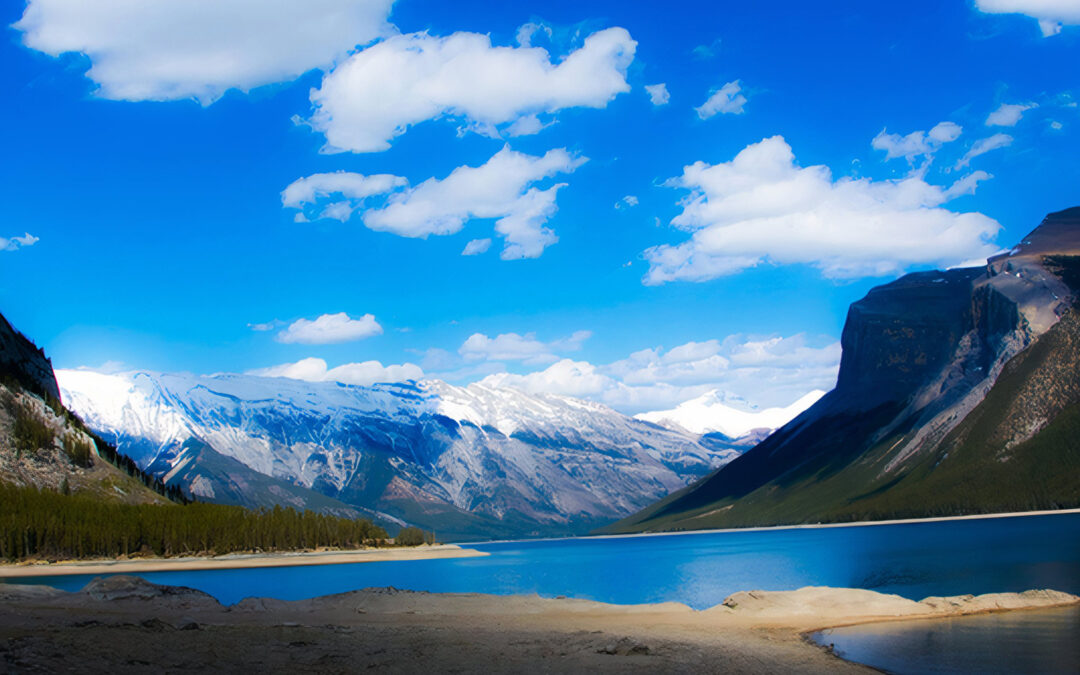
Banff National Park is a great place to hike or sightsee, with lakes, waterfalls, and other natural features throughout. Canada’s oldest national park, located in Alberta, and one of the largest in North America, also appears to host a mysterious underground structure.
It is not confirmed exactly when the recent find was built or what it even is. The structure is at a lake in the park, which has an underwater ghost town in its depths.
Mysterious Structure Found Beneath Banff National Park
The find was recently discovered at the beach near Lake Minnewanka, after a part of the ground collapsed. Parks Canada responded to the situation in early May, and it was then that staff determined the hole was caused by a “roof of a previously unknown underground structure” caving in, according to Canadian outlet CTV News.
Parks Canada is the federal agency tasked with managing the country’s natural and historic sites.
The agency said the underground structure seems to be made of untreated wood, with log walls and rough-cut planks. It’s not clear exactly what the structure is, however.
No historical plan or photograph gives any clue as to what it is. Officials do have a theory, though. And it’s possible the building dates back before the 1960s.
“It is possible that this feature was related to the Lake Minnewanka Campground and was likely installed in early 1944,” Parks Canada said in a statement on June 16. “Heritage specialists are assessing the site to better understand the structure’s origin and any potential heritage or archaeological significance.”
Before the grounds were turned into a day-use area for Two Jack Lake Campground, the site was the Lake Minnewanka Campground. This campground closed in 1952.
And officials are aiming to keep the structure around.
“Once assessments are complete, Parks Canada staff will proceed with remediation work to stabilize and restore the site using standard environmental and safety protocols,” said Tomi Postma, acting public relations and communications officer for Banff National Park, in an email to Rocky Mountain Outlook.
Officials are asking visitors to avoid the fenced area for safety reasons.
“The ground around the structure is unstable and further localized collapse may occur,” Postma said. “The fencing marks and secures the area of concern, and no risks have been identified beyond it.”
Lake Minnewanka has a rich history that goes back thousands of years.
Breakdown Of The History Of Lake Minnewanka

Lake Minnewanka’s shoreline hasn’t always looked the way it does today. The lake was first dammed in 1895 to improve its boggy edges for boating, then again in 1912 to store water for a downstream hydroelectric plant along the Cascade River.
According to Parks Canada, the lake was once home to a lakeside community. Beyond that, the lake also holds significant Indigenous archaeological sites, with artifacts dating back as far as 14,000 years.

But the lakeside community first sprouted in the summer of 1886, when a log hotel known as the Beach House was built along the original shoreline, drawing crowds eager to escape Calgary’s heat. By 1912, that had grown into a summer village called Minnewanka Landing, laid out with four avenues and three streets, and became a popular sailing destination.
The town also featured wharves, restaurants, and sailing tours aboard two cruise boats.
A new dam was eventually completed in 1941 due to surging demand for electricity as Calgary expanded during World War II. The waters of Lake Minnewanka rose by nearly 100 feet — submerging the town entirely in icy waters. Today, much of that history lies beneath the surface.
What Lies Underneath The Surface Of Lake Minnewanka
Despite the lake’s popularity for boating and kayaking, the town itself is not visible from above. The only real way to access it is by scuba diving. Over the years, divers have uncovered remnants of the submerged town, along with other artifacts. In 2025, a team of scuba divers made a notable discovery when they located a 1928 Hudson Essex Saloon at the bottom of the lake, helping solve a decades-old mystery surrounding the vehicle.
Even then, conditions can be challenging. The site lies at depths of roughly 57 to 80 feet, and visibility can fluctuate throughout the year. Access is limited, with some structures deteriorating over time, and the area is only reachable by boat — often in waters busy with fishing traffic.

Still, parts of the town remain. Divers have reported seeing sidewalks and structural remnants, including sections of early dams from 1895 and 1912. The wharf that once launched sailing tours has also partially survived beneath the water.
The submerged village has contributed to the lake’s reputation as an eerie place. Local legends speak of spirits lingering below the surface, while urban myths have gone even further, claiming something more unusual may be lurking in the depths — a grotesque murman.
While those are just myths, the mysterious underground structure and the remnants of a long-lost lakeside village suggest that Lake Minnewanka may still be holding onto more of its history beneath the surface and in the surrounding area than may be fully realized.

Recent Comments