
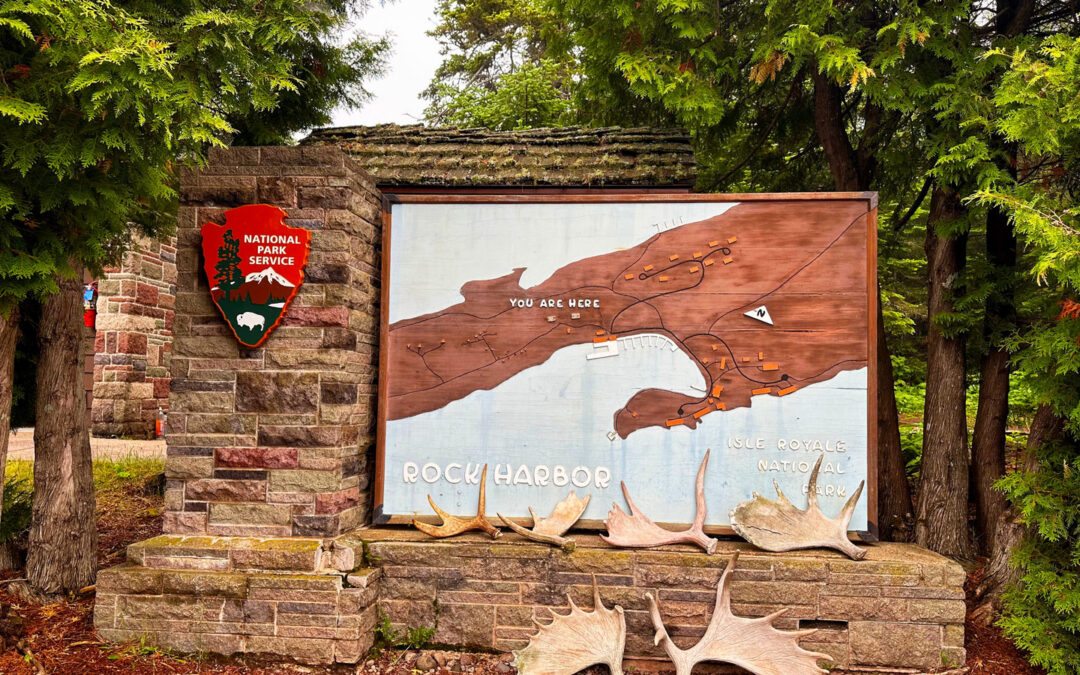
Located on Lake Superior in Michigan, Isle Royale National Park is a remote island accessible only by ferry or seaplane. Its isolation makes it one of the country’s least-visited national parks. But those who do make the journey can explore the island by hiking, paddling, backpacking, or staying at one of its 36 campgrounds.
The park is home to several wildlife species, including moose, beavers, red foxes, and gray wolves. Scientists think the wolves first got to the island by crossing an ice bridge from Canada in the late 1940s. However, the population eventually dropped to just two wolves from 2016 to 2018. The National Park Service then relocated 19 wolves from other areas in the Great Lakes region to Isle Royale from 2018 to 2019 to boost the population.
But now, parkgoers are having more encounters with one specific wolf. Officials say the animal has been frequenting camping areas, which has led to temporary restrictions at several campsites.
Isle Royale National Park Restricts Camping After Wolf Encounters Escalate

On July 9, Isle Royale National Park announced the temporary closure of individual tent and group sites at Three Mile Campground. Officials have also closed surrounding off-trail camping zones and prohibited the use of tents and hammocks.
The restrictions come after a series of encounters reported last week. According to the National Park Service, a wolf sniffed and pawed at tents, dragged backpacks away, and entered at least one tent. Officials said the animal was showing signs of becoming reliant on food brought into the park by humans.
“Over the past week, a wolf has been spotted in the campground, sniffing and pawing at tents, dragging backpacks away from tents, and entering a tent. The wolf has become increasingly bold, showing signs of habituation and a growing reliance on human food,” park officials wrote in a news release.
To mitigate the issue, park employees will attempt to deter the wolf from returning to the campsite by using a series of “hazing” methods.
“Hazing methods include loudly shouting, stomping, clapping, sounding airhorns, and discharging paintball guns. Staff will also install noise-producing devices around Rock Harbor, Three Mile, and Daisy Farm Campgrounds to alert staff and visitors of wolf presence,” the news release states.
The restrictions are currently scheduled to remain in effect through July 31. However, officials warned that the closure could be extended, and additional areas could face restrictions if the problem continues.
Visitors Blame Careless Campers For The Wolf Encounters
After the National Park Service announced the restrictions, some parkgoers blamed careless campers. In a Reddit discussion, commenters questioned why visitors would leave food on picnic tables, store it inside tents, or walk away from backpacks containing scented items.
Parkgoers also called for tighter limits on visitors to the island. One suggested that popular campgrounds could eventually become shelter-only, which would reduce the number of people able to stay overnight. Another went further, saying that Isle Royale should be off-limits to humans altogether.
|
“Isle Royale should be off-limits to humans.” |
|
“Now the tent sites will be full at Daisy Farm, and the problem will get worse there. I just got back, and on my first time through Daisy, someone a few sites down had a wolf come through. [On] my second time at Daisy, I had a wolf at my shelter site. Wouldn’t be shocked if all the popular campgrounds on the southeast side become shelter-only before long.” |
|
“That’s an interesting solution I hadn’t thought of. That would severely restrict the number of visitors if shelter-only. (which is fine by me).” |
Several parkgoers also worried about what could happen to the animal if the encounters continue, one writing, “I fear for this wolf.”
This Isn’t The First Time A Wolf Has Been Sighted In Isle Royale’s Campgrounds
Those concerns aren’t unfounded. In August 2025, Isle Royale officials lethally removed a food-conditioned wolf after it repeatedly entered developed areas and took backpacks and food-storage bags from campsites.
“Our priority remains the safety of park visitors and staff, and the protection of wildlife in their natural state, including our objective to maintain a wild wolf population. While lethal removal is deeply unfortunate, it became necessary due to a growing public safety risk. All who appreciate and enjoy Isle Royale National Park need to understand the importance of adherence and vigilance to food storage regulations and our collective role in minimizing negative human-wildlife interactions,” Isle Royale Superintendent Denice Swanke said in a news release.
While visitors are unlikely to be banned from Isle Royale, following the park’s food-storage rules could help prevent another wolf from ultimately paying the price for human mistakes.
Responsible Camping Can Protect Both Visitors And Wolves

In April 2026, Isle Royale National Park began implementing new regulations requiring backpackers, campers, paddlers, and boaters to store food, trash, and other scented items in food storage lockers or an approved hard-sided container.
The new guidance also states that food and scented items should never be kept inside tents or shelters, and backpacks should never be left unattended. Campers are also prohibited from hanging food at established campgrounds.
What To Do If You Encounter A Wolf
Most wolves naturally avoid humans. However, anyone who encounters one should keep their distance and never attempt to approach or feed it. Recent incidents at other national parks have shown just how unpredictable wildlife can be, including a Yellowstone bison that flung a visitor into the air before reportedly targeting other guests.
If a wolf continues advancing, the National Park Service advises visitors to keep eye contact, back away, and make noise without running. Once safe, be sure to report the incident to park staff.

In the unlikely event of a wolf attack, the National Park Service says to “fight using any means necessary.”
Ultimately, following the park’s rules helps prevent wolves from associating people with meals. These guidelines also keep future visitors safe while allowing Isle Royale’s wolves to remain wild.

Recent Comments