
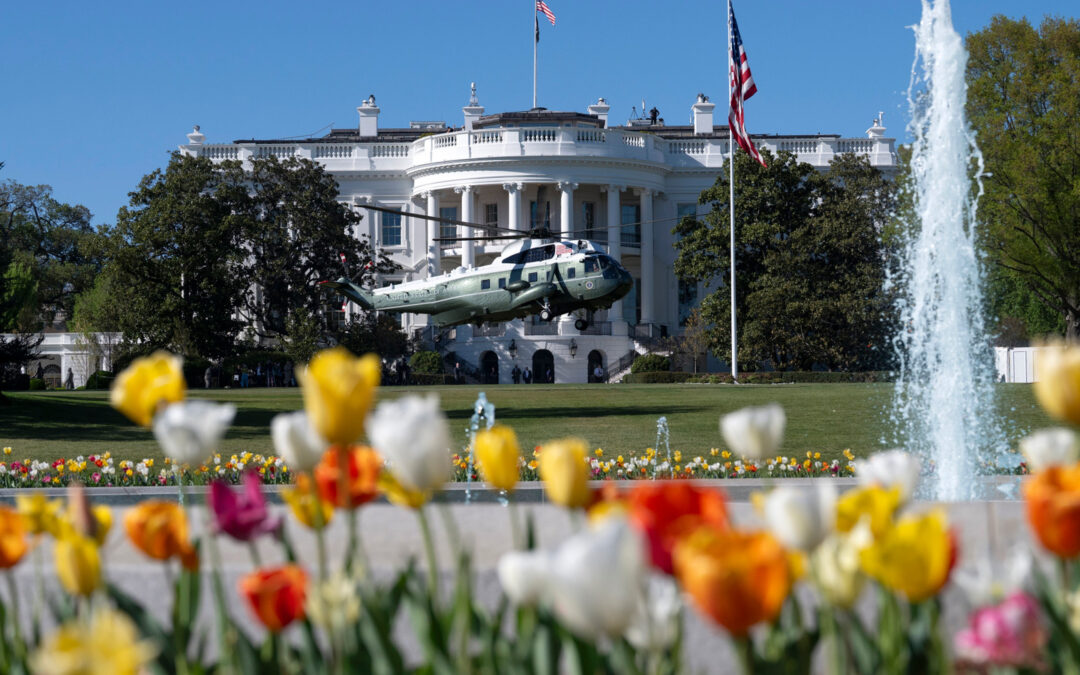
1600 Pennsylvania Avenue might soon get a new addition. The Trump Administration has begun construction of a helipad on the South Lawn of the White House, according to a Washington Post report based on three people who spoke on the condition of anonymity. The individuals remained unnamed since they lacked the authorization to publicly announce the project, the newspaper reports.
The helipad, reportedly being built for Marine One, is part of President Donald Trump’s latest “beautification” project in Washington, D.C., and some of the funding is coming from travelers — with the use of national park entrance fees. Some of Trump’s other plans for the capital include the “Trump Promenade,” a proposed walkway at the Lincoln Memorial, and the United States Triumphal Arch.
Breakdown Of Report Of Trump’s Latest “Beautification” Project

On June 29, construction crews worked into the night on the South Lawn and were blocked off by a large fence, according to the Washington Post, which reported that the helipad will be located near the South Portico, the traditional landing and departure site for Marine One.
Marine One is the call sign for whichever helicopter is carrying the president.
The White House has not publicly announced the project. TheTravel contacted the White House to confirm the construction, but did not receive a response in time for publishing.
The helipad is not an addition that serves no purpose, however.
Ray L’Heureux, a retired Marine Corps colonel who previously commanded the Marine Helicopter Squadron One and was the personal pilot for former presidents Bush and Obama, told TheTravel that he believes the issue is the “significant scorching effect” that the newest member of the fleet would have on the lawn.

The newer Marine One helicopters — the Sikorsky Aircraft-manufactured VH-92A Patriot — have exhaust vents that aim heat downward, increasing the likelihood of burning the grass below.
L’Heureux, who suggested to the Washington Post that using green concrete would help the helipad blend in to the lawn, told TheTravel that the project was likely the “last option” to address the scorching issue “but came out to be the most necessary.”
More Information On Issues With The Next Generation Helicopter

L’Heureux noted that helicopters have previously damaged the lawn in very rare instances by leaving an indentation after extended periods of rain. He told TheTravel that a portable landing coaster is sometimes used on the White House lawn to mitigate the effects of landing; however, this would not be a solution to the newer helicopter’s scorching issue.
L’Heureux explained that the VH-92A Patriot’s exhaust plume is so wide — and combined with wind — that it would effectively create a “stencil” of the disc it’s landing on.
L’Heureux said the helicopter has been used by the president but has been restricted from White House use until a solution is devised. He said that the older generation of helicopters still “needed to be replaced.”
“You want the latest and greatest technology-wise,” L’Heureux told TheTravel.
Lockheed Martin, which owns Sikorsky Aircraft, donated $5 million to pay for the helipad, according to a company official familiar with the project speaking to the Washington Post.
TheTravel contacted Lockheed Martin to confirm the donation.
Previous administrations have considered building a helipad but ultimately dismissed plans over concerns that it would “alter an iconic image” of a U.S. president departing and arriving on the White House lawn, the newspaper reports.

The helipad comes as the latest White House alteration by Trump, who previously demolished the East Wing to make way for his $600 million ballroom.
It remains unclear when the reported helipad project will be completed or announced. Funding for Trump’s Washington, D.C. projects appears to have come partly from National Parks.
Fees At National Parks Have Helped Fund Trump’s Projects

The National Park Service is using at least $67 million from entrance fees to help fund Washington projects, including renovations to the Lincoln Memorial Reflecting Pool. A New York Times analysis of federal records found that nearly $60 million from national park fees has helped fund nine of the capital’s fountains.

The Lincoln Memorial Reflecting Pool, which cost $13.1 million, received $7 million of its funding from entrance fees — roughly 53% of the project’s cost. With many national parks in need of repairs, the decision has drawn scrutiny.
Aaron Weiss, the executive director of the conservation group Center for Western Priorities, has called out Interior Secretary Doug Burgum — the Department of the Interior allocates funds for public projects.
“Our parks and public lands have been underfunded for decades, and there are many genuinely urgent projects in need of funding across the country. Instead, Interior Secretary Doug Burgum is determined to divert millions of dollars to projects that President Trump can see out his window,” Weiss said.
Katie Martin, a spokeswoman for the Interior Department, told the New York Times that “we should all be grateful” for President Trump’s focus on projects in D.C.
Steve Coleman, the executive director of the advocacy group Washington Parks & People, defended the use of funds.
“This is a very fitting use of fee dollars. The entire country benefits from the fact that there is no charge to enter any D.C. national park, but hundreds of our inner-city park sites beyond the National Mall suffer from the fact that D.C. has no representation in Congress and thus has to beg for crumbs,” Coleman said.
While a project like the helipad arises from necessity, many of these projects don’t meet that need, and national park visitors don’t have a choice about where the U.S. government spends their entry fees.

Recent Comments