
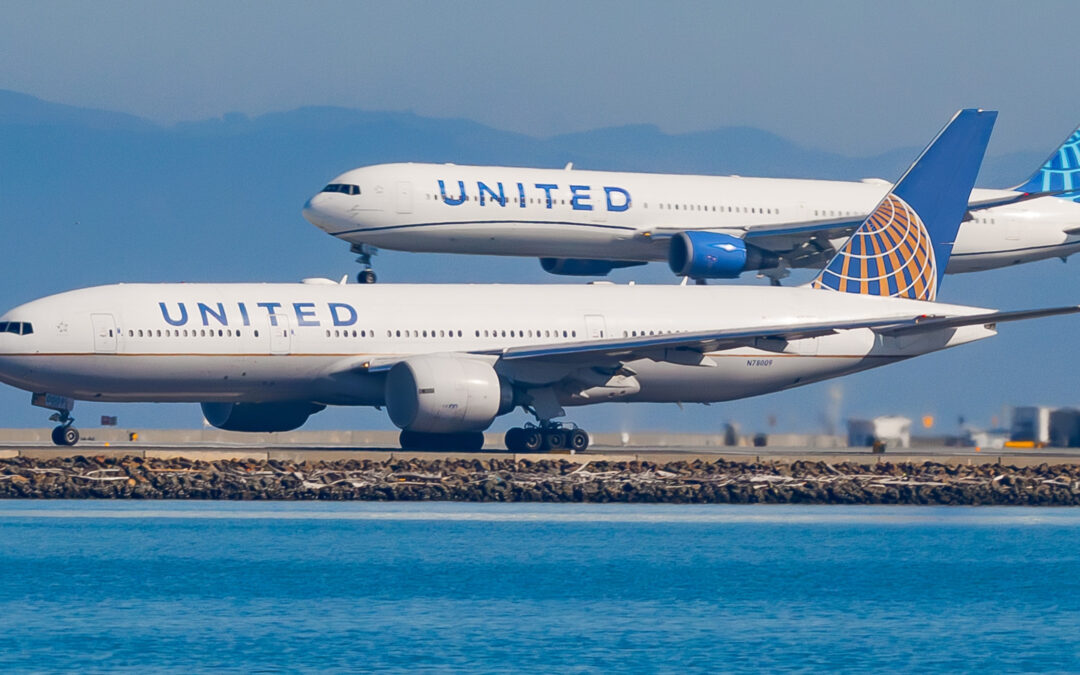
A United Airlines hub no longer has planes performing parallel landings, which has quadrupled the average delay time. The Federal Aviation Administration (FAA) shut down the procedure at San Francisco International Airport (SFO) in early April. United Airlines holds the larger market share at the airport.
This change followed American Airlines Flight 5342, in which the passenger plane collided with a U.S. Army Black Hawk helicopter on Jan. 29, 2025, over Washington Reagan National Airport (DCA), killing all 67 people aboard both aircraft. A former Delta Air Lines pilot has now called out SFO’s change. This comes after the airport issued a ground stop earlier this month.

Lieutenant Colonel Robert “Buzz” Patterson reposted a video on X that showed a Southwest Airlines and a United Airlines aircraft performing a side-by-side takeoff at SFO. Patterson, who, according to his LinkedIn, was a Delta pilot and first officer for over 15 years, wrote in the post that he used to perform these procedures.
“We used to do parallel arrivals and departures at SFO. No longer. I used to love flying them. Too many guys screwed it up unfortunately,” he wrote.
Patterson added that passengers should “Expect longer taxi times and gate holds.”
The retired United States Air Force pilot’s claim is not unfounded. According to an analysis by the San Francisco Chronicle, the average flight delay time has increased from 5 to 20 minutes — marking a fourfold increase.
The analysis examined delays from April 1 to June 10, comparing that with the same period in 2025. Specifically, arrivals have experienced a delay rate greater than 50% at the peak hours of 1:00 p.m. and 9:00 p.m.
“We continue to work with the FAA to improve arrival rates at SFO while ensuring that safety remains our highest priority and are encouraged by other reporting of progress on this topic,” SFO spokesman Doug Yakel told TheTravel, linking an article from Simple Flying.
The FAA officially shut down parallel landings at SFO on April 1. TheTravel contacted the FAA for comment but did not immediately receive a response in time for publishing.
Why The FAA Banned Parallel Landings At SFO
The Bay Area airport, the thirteenth busiest in the U.S., has two runways that run east and west that are a mere 750 feet apart — closer than any other parallel airstrips at a major U.S. hub. Due to the narrow separation, pilots were required to use visual confirmation to safely land. This was permitted only under an FAA waiver and when the weather was clear. Since American Airlines Flight 5342, airports now must always use positive air traffic control with radar monitoring.
SFO would need at least 2,500 feet of separation between runways to resume parallel landings.
There have been a couple of close calls this year as well. A plane and a helicopter came within a few hundred feet of each other at San Antonio International Airport (SAT) and John Wayne Airport (SNA).
Delays have increased because SFO is not equipped to handle its normal capacity under these new rules; in addition, the north-south runway is closed for construction to resurface and modernize. Yakel told the SF Chronicle that delays were 1.8 times more likely until May 16. The local outlet’s data, however, show that this has continued through June.
The FAA confirmed the delays in a statement to the SF Chronicle.
“San Francisco International Airport (SFO) will experience some flight delays due to a runway repaving project and an FAA safety measure. It requires staggered approaches, with one aircraft offset from the aircraft on the parallel runway,” the agency stated.
Even though delays are up at the airport now, the FAA may be introducing technology and procedures to mitigate them.
How The FAA May Help SFO Cut Down On Its Longer Delays

The runway construction, costing a whopping $180 million, will improve capacity and is slated for completion in October. But other changes could also help address delays. The Simple Flying article that Yakel cited in his statement to TheTravel notes that the FAA could introduce advanced precision runway-monitored (PRM) approaches and closely spaced parallel approach (CSPA) procedures at SFO.
PRM is an advanced radar monitoring system aimed at improving the use of parallel runways during poor weather conditions, according to an article by MIT’s Lincoln Laboratory. The system would use a high-speed radar-scanning array that provides updates every second during approaches. Planes would once again be able to maintain less separation from each other, since it would allow more accurate ATC control. CSPA would also help with this, as it uses Automatic Dependent Surveillance-Broadcast (ADS-B).
ADS-B is a technology that broadcasts an aircraft’s position and other data, enabling ATC and other aircraft to track the plane more accurately.
According to Simple Flying, the systems would be combined, with PRM most helpful for keeping planes laterally separated and CSPA for front-to-back separation. While travelers who frequent SFO should continue to expect delays, changes could come soon on the horizon that would make the airport more efficient once again.

Recent Comments