
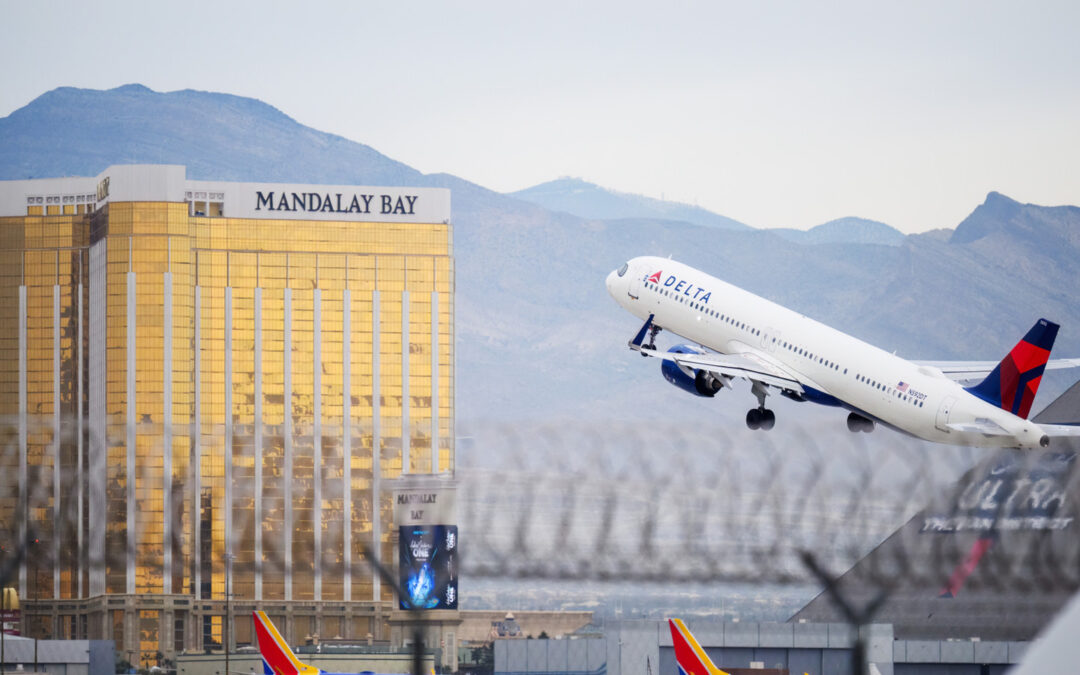
2025 was a challenging year for Las Vegas as a global tourism destination, driven by the so-called “Trump Slump.” The city’s decline in visitors, especially Canadians, whose travel boycott hit Sin City hard, left a noticeable void not just in its pockets but also its airport; last year, footage of an unusually empty-looking Harry Reid International Airport caused a stir on social media. Even though tourists seemingly abandoned the idea of Las Vegas vacations, it would seem an arguably more important type of traveler hasn’t — and Delta Air Lines looks to be betting on their continued travel.
In an announcement on June 26, Delta confirmed it will expand both domestic and international flights to Las Vegas for CES 2027 in a bid to connect one of the world’s biggest technology events with key innovation hubs across the globe. And who does an event like this attract? Indeed, business travelers. In fact, the U.S. was the top business travel destination in 2025, and it appears to be in line for the same fate this year through the rise of “bleisure” visitors (leisure plus business).
While leisure tourism has seen a sharp decline over the past year, Delta’s new move suggests the carrier sees business travel, particularly in Las Vegas, as a major opportunity heading into 2027. But can this move make up for Vegas’ tourism loss?
Delta’s New Routes To Las Vegas For CES 2027 Business Travel

Delta’s announcement confirmed that the carrier will operate more than 120 peak day flights to Las Vegas for CES 2027. Chief among the flights include two brand-new nonstop routes from Asia and increased frequencies from several major U.S. cities.
The boosted Las Vegas flights include those from several American business centers, such as Austin, Boston, Atlanta and San Jose, reflecting where many technology companies and startups are based.
|
Route |
Change |
|
Hong Kong (HKG) – Las Vegas |
New nonstop service |
|
Taipei (TPE) – Las Vegas |
New nonstop service |
|
Seoul (ICN) – Las Vegas |
Additional flights |
|
Atlanta (ATL) – Las Vegas |
Increased service |
|
Austin (AUS) – Las Vegas |
Expanded to twice daily |
|
Boston (BOS) – Las Vegas |
Additional flights |
|
Detroit (DTW) – Las Vegas |
Additional flights |
|
Fort Lauderdale (FLL) – Las Vegas |
Additional flights |
|
Los Angeles (LAX) – Las Vegas |
Additional flights |
|
Miami (MIA) – Las Vegas |
Additional flights |
|
Minneapolis (MSP) – Las Vegas |
Additional flights |
|
New York (JFK) – Las Vegas |
Additional flights |
|
Orlando (MCO) – Las Vegas |
Additional flights |
|
San Diego (SAN) – Las Vegas |
Additional flights |
|
San Jose (SJC) – Las Vegas |
Increased from one to three daily flights |
|
Seattle (SEA) – Las Vegas |
Additional flights |
Instead of focusing on traditional vacation markets, Delta’s latest expansion seems to be designed around the travel patterns for CES attendees. Held annually in Las Vegas, CES attracts more than 140,000 attendees from across the planet, including executives, investors, engineers, entrepreneurs, and media representatives.
“CES continues to be one of the most important global events for innovation and Delta is uniquely positioned to connect customers to Las Vegas from across our network,” said Jeff Arinder, Delta’s Vice President of International Network Planning said.
According to Delta, the schedule is specifically designed to coincide with the world’s largest consumer show. “With new service from Hong Kong and Taipei and expanded flying from key U.S. markets like Austin, we’re making it easier than ever for customers to access CES with a premium, seamless travel experience,” Arinder added.

Delta’s expansion is a clear indicator of how important CES has become for airlines. Unlike traditional leisure travelers, convention attendees can be more lucrative because they often book flights at higher fares and travel on weekdays. Naturally, they’re also valuable for destinations like Las Vegas that rely on visitors for their economy, since they usually stay in premium hotels and spend on dining and entertainment.
Adding to that is business travelers’ financial importance to the U.S. as well. And fortunately for America, business travel has remained quite solid over the past year, even in the face of a major international tourism dip.
Business Remains One Of The Most Valuable U.S. Travel Sectors

Delta’s decision to throw more CES-focused route into the mix mirrors a wider travel trend taking place not throughout the American travel industry, but throughout Las Vegas. The city, synonymous with casinos and entertainment, has become one of North America’s largest and most frequented convention destinations.
Throughout the year, Vegas hosts major events spanning technology, healthcare, construction, hospitality, and manufacturing, bringing millions of business travelers to Southern Nevada. CES is the premier event on that calendar; the convention not only fills hotels across the Las Vegas Strip but also drives demand for restaurants, transportation services, entertainment venues, and local businesses.
Many attendees also choose to arrive early or remain after the conference ends, and that creates additional tourism spending beyond the actual event itself.

While international leisure tourism has softened over the past year, business travel, or “bleisure”, has continued to outperform many other travel segments. The U.S. remained the world’s largest business travel market last year, generating hundreds of billions of dollars in spending and reinforcing its position as the leading destination for corporate travel.
America’s so-far successful “bleisure” trend is expected to continue throughout 2026, particularly as companies are beginning to focus more on international meetups and conferences while employees increasingly combine work trips with leisure travel. That growing trend has become of the biggest drivers of tourism demand this year.
Rather than flying home immediately after meetings or conventions, a lot of corporate travelers are extending their stays to explore the destinations they’re visiting on business. And with that traveler behavior comes the possibility of two birds with one stone for U.S. destination facing tourism shortfall, like Las Vegas. Although, the question of whether business travelers can make up for the city’s leisure tourism downfall in the last year still lingers.
Las Vegas Hopes Business Travelers Can Offset Lower Tourism

As mentioned, Delta’s expansion of both domestic and international flights to Las Vegas may well be for the CES event, but it also arrives after a challenging year of tourism for the city. International travel to the U.S. weakened throughout 2025 amid what many deemed as the “Trump Slump”, driven by a general negative sentiment toward Trump administration policies, from tariffs to border and immigration enforcement, and an overall unfriendly view of America on the global stage.
Four million fewer tourists visited the U.S.last year compared to 2024, according the National Travel and Tourism Office (NTTO), representing a visitor loss of around 5.5%. That downward trend is a stark contrast to tourism around the world; global travel injected a record $11.6 trillion to the worldwide economy, per a report released in April 2026 by the World Travel & Tourism Council (WTTC). However, that golden river didn’t particular run to the U.S., which was the only country out of 184 that was forecast to experience a decline in international visitor spending at the same time.

Given the grim trends, plenty of U.S. destinations thus saw declines in overseas visitors; however, Las Vegas was among the cities hit the hardest. One of the most prominent factors was the sharp decline in Canadian tourism following trade tensions and political rhetoric between the United States and Canada.
Canada has traditionally been one of Las Vegas’ largest international visitor markets, alongside Mexico, making the decline especially significant for the city’s tourism industry. Overall, Las Vegas lost around 17% of its Canadian visitors during 2025, which added to the broader decline in international arrivals from major overseas markets, including in Europe and Asia. But Las Vegas didn’t see a drop in only Canadian visitors.

In an annual report issued at the end of January 2026, the Las Vegas Convention and Visitors Authority (LVCVA), highlighted the city’s total visitors at approximately 38,545,700 visitors, which is a 7.5% decline from the previous year. Ultimately, with Delta’s latest route additions, hopes for a rebound in Vegas’ tourism numbers seem fruitful — or, it may help create a continued steady stream of business travelers at the very least.

Recent Comments