
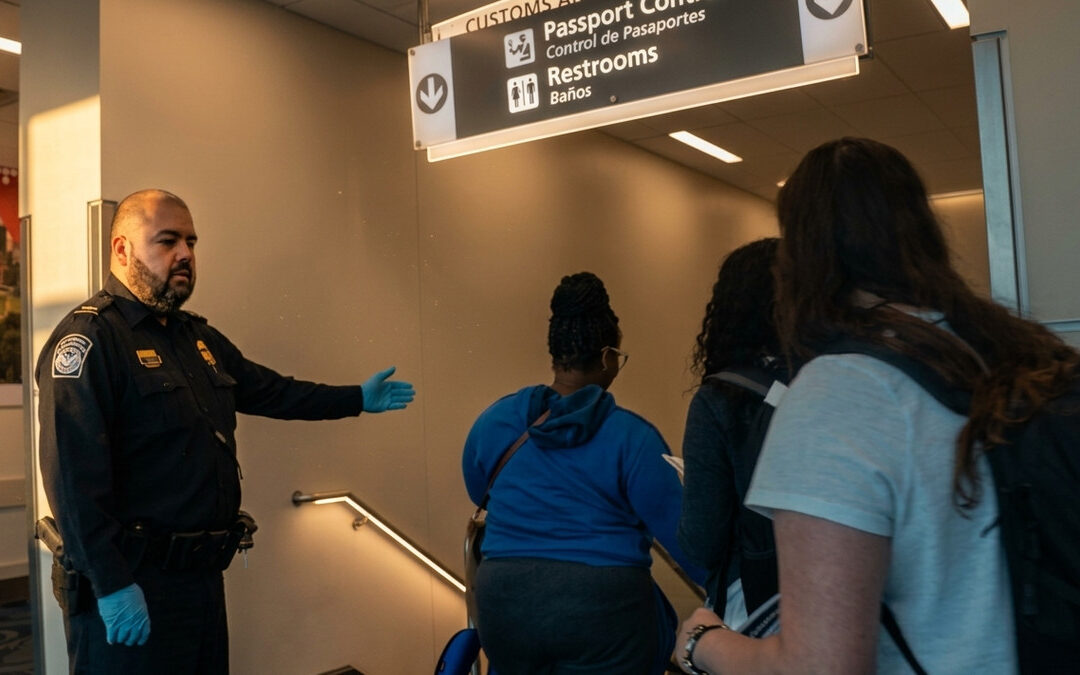
U.S. Customs and Border Protection (CBP) recently warned travelers that “everything gets inspected” at borders. Airports, in particular, have seen a spike in intense enforcement. Incidents range from border officers marching passengers off a flight at Houston Airport to an American having their phone confiscated over a luggage sticker at Boston Logan International Airport (BOS).
For foreign travelers, however, these encounters can escalate to full U.S. entry bans. This is what happened to a Hartsfield-Jackson Atlanta International Airport (ATL) passenger, who ended up having an emotional breakdown during a 12-hour detention. While these interrogations are usually caused by clear red flags, this experience was anything but straightforward.
CBP Bans ‘Clean Record’ Mexican Traveler At ATL After 12-Hour Detention

On Monday, a Mexican traveler shared a detailed account of CBP revoking their B1/B2 visa and issuing them a five-year ban at ATL Airport. At the time, they were catching a connecting flight in Atlanta from San José del Cabo, Mexico, en route to an expo in Washington, D.C.
Their Global Entry membership had also just been approved, two months prior. Beyond the shock from the ban, the traveler recalled how a border officer’s remarks during the 12-hour interrogation left them even more confused.
“I want to be completely transparent: I had an emotional breakdown during this experience. I was overwhelmed, frightened, and confused,” they wrote on Reddit. “Nothing like this had ever happened to me, and the experience genuinely changed me. One thing that has stayed with me is something the officer who interrogated me said during that breakdown. He told me something along the lines of: ‘Your entries and departures are clean. Your record is clean. I encourage you, when you return home, to try to resolve and clear up this situation.'”
It was not their first time visiting the U.S. either. They have previously entered the country mostly for vacations and shopping, never been detained or overstayed, or “knowingly violated any immigration laws.” During this trip, they even had a confirmed onward flight ticket to Europe to prove that their visit to the U.S. was temporary.

Additionally, a business (B-1) visitor visa covers short-term business activities like meetings and conferences, which applies to the expo the ATL passenger was supposed to attend. B-1 visas are routinely issued alongside B-2 tourist visas as a combined B1/B2 visa, which also permits holiday travel, family visits, and medical treatment.
CBP Records Reveal ATL Passenger Was Deemed ‘Inadmissible’

While the Mexican traveler understood that their clean record did not guarantee admission to the U.S., they ended up hiring an immigration lawyer to further investigate the mysterious ban. After submitting a Freedom of Information Act (FOIA) request, they were able to see that CBP had deemed them “inadmissible” in relation to “immigration documentation.”
|
CBP’s Records On Mexican Traveler’s Mysterious 5-Year Ban |
|
|
Visa revocation |
Canceled B1/B2 visa |
|
Inadmissibility |
INA § 212(a)(7)(A)(i)(I), relating to immigration documentation. |
|
Expedited removal |
An order issued under INA § 235(b)(1), documented on Form I-860 |
|
Five-year ban |
Consequence of the expedited removal |
|
No explicit fraud finding |
No formal finding under INA § 212(a)(6)(C)(i) |
An INA § 212(a)(7)(A)(i)(I) finding typically means the individual lacked a proper, valid, unexpired immigrant visa or reentry permit or other required entry document. This points to CBP officers suspecting the Mexican traveler of using their B1/B2 visa to permanently live, work, or study in the U.S. Some Redditors suggested that perhaps it was set off by information found on their phone.

However, the ATL passenger said their personal belongings were never searched during the ordeal. Instead, border officers focused heavily on biometric processing. The traveler’s fingerprints were taken, and they were “swabbed for what [they] understood to be DNA collection.”
“When I asked what [the swab] was for, the officers told me something along the lines of, ‘It’s to check whether you’ve committed any crimes internationally,’ and explained that it was simply part of their standard procedure,” they recalled in a comment to their own Reddit post. “I wasn’t told whether it was specifically a DNA test or some other type of screening. I just know they collected a sample from inside my mouth.”
The tourist was locked in the CBP detention room at ATL Airport from around 7 p.m. until they were put on a flight back to Mexico the next day at 9 a.m. They were told that they had to stay there because there were no available flights that evening. TheTravel reached out to CBP for comment.
Why CBP Can Deem Tourists ‘Inadmissible’ Despite Valid Visa
A valid tourist visa or Electronic System for Travel Authorization (ESTA) does not guarantee admission into the U.S. It simply permits individuals to travel to a port of entry and then request entry. CBP officers ultimately evaluate whether a traveler is admissible based on various factors.
“Customs and Border Protection inspects all travelers seeking admission to the United States and determines admissibility at the port of entry based on the traveler’s documentation, stated purpose of travel, eligibility, and information available at the time of inspection,” a CBP spokesperson told TheTravel.
Illustrating how strict these assessments could be, TheTravel previously reported on CBP indefinitely banning a Canadian traveler for visiting her American boyfriend too much despite “following all the rules” for entry and stay limits.
Cases like this further highlight how frequent trips to the U.S. remain subject to scrutiny and broad officer discretion, contrary to the Mexican visitor’s expectation that his past legal entries would mean a smoother passage.
All foreign nationals seeking entry into the U.S. are subject to the strict willful misrepresentation rules under the Immigration and Nationality Act (INA) § 212(a)(6)(C)(i). Providing inaccurate, inconsistent, or contradictory answers to a CBP officer can give them reasonable grounds for investigation and issuance of this finding.
Furthermore, membership in Trusted Traveler Programs (TTP), such as Global Entry or NEXUS, also does not give individuals any special immunity from these protocols. Recently, even a veteran Republican traveler holding an active government security clearance lost their Global Entry with no indication why.
A CBP spokesperson told TheTravel that travelers who believe they were wrongly delayed, denied boarding, or subjected to additional screening may seek redress through the CBP and/or the Department of Homeland Security (DHS) Traveler Redress Inquiry Program.

Recent Comments