
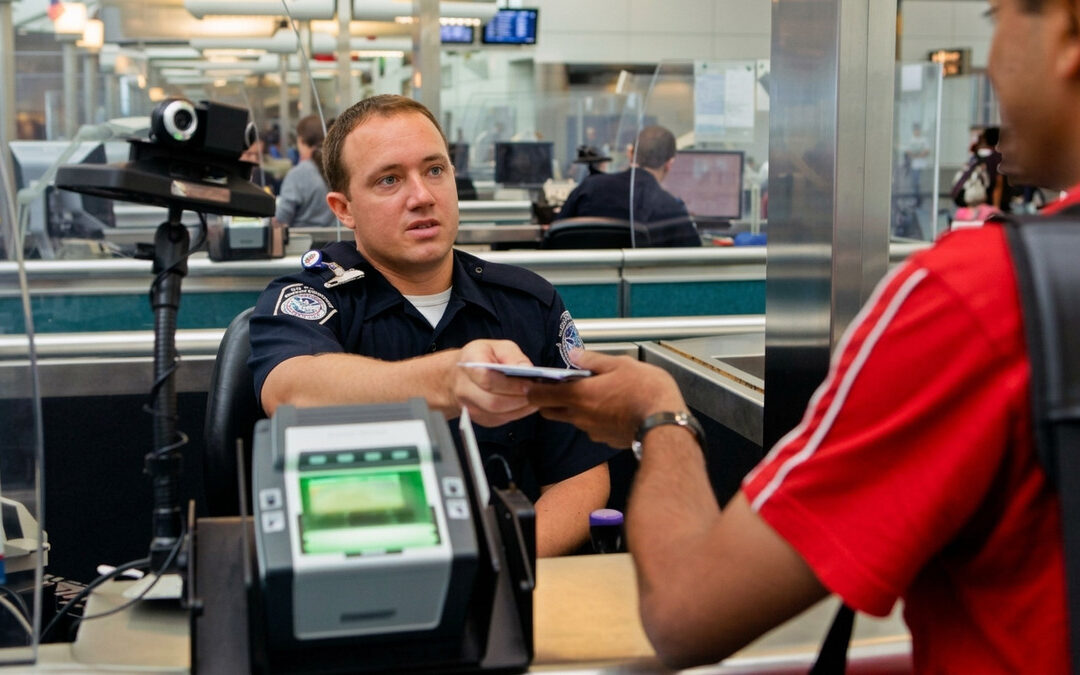
U.S. Customs and Border Protection (CBP) continues to remind travelers that “everything gets inspected,” as it ramps up security protocols across U.S. ports of entry—from facial biometric lanes now live at seven land border crossings to a newly expanded device search authority for Americans and foreign nationals alike.
Some travelers say they have lost Trusted Traveler status without explanation. A traveler who described themselves as a veteran and registered Republican said on Reddit that their Global Entry was revoked with “no indication why,” prompting commenters to speculate that online shopping could be to blame.
CBP Revokes Republican Veteran Traveler’s Global Entry: Online Shopping Blamed

Last week, an American traveler took to Reddit, hoping to get an answer as to why his Global Entry membership was revoked, alongside its included TSA PreCheck benefits, without any explanation. The individual found out about it at the airport after experiencing “embarrassment at the gate.” They initially assumed that they had only failed to renew it, but later realized it was not the case after going through the brief email notification.
|
CBP’s Trusted Traveler Programs (TTP) |
|
|
Expedited customs clearance for international travelers arriving in the U.S. using dedicated kiosks, e-gates, or the official mobile app |
|
|
Jointly administered with Canada to expedite entry for pre-screened travelers traveling by air, land, and boat between the U.S. and Canada |
|
|
SENTRI (Secure Electronic Network for Travelers Rapid Inspection) |
Expedited clearance for pre-approved, low-risk travelers arriving in the U.S. from Mexico |
|
FAST (Free and Secure Trade) |
Commercial clearance program for expedited low-risk shipments crossing U.S. borders from Canada and Mexico |
|
Expedited airport security screening; administered by the Transportation Security Administration (TSA) but included in Global Entry (all members), NEXUS (U.S./Canadian citizens, U.S. lawful permanent residents), and SENTRI (U.S. citizens and residents) |
|
Some suggested that it could be due to political posts on social media. But the traveler—who described themselves as a veteran, registered Republican, and government employee with active security clearance—is confident that does not apply to them. However, the majority of the comments pointed to online shopping as the possible reason that caught the poster’s attention.
Many commenters suspected that purchases from China-founded e-commerce platforms Temu and Shein may be the reason for the traveler losing their Global Entry status. It is a theory that has been floating around internet discussions about canceled Trusted Traveler memberships.
The government worker then edited their post, saying they do not buy from Temu but “occasionally” shop from Shein. Still, they believe that would be a “strange” cause, if ever. While shopping from these online marketplaces is not explicitly banned by federal authorities, certain items or related activities can still be flagged for regulatory violations, triggering an automatic loss of privileged traveler status.

When asked about the online shopping speculation regarding the traveler’s case, a CBP spokesperson explained to TheTravel the wider range of potential factors behind the cancellation of their Global Entry. They stressed that these decisions are determined by eligibility conditions and continued compliance, including with immigration and customs laws. This is when shopping, online or abroad, may become a hidden risk for Trusted Travelers.
“Global Entry® is a discretionary Trusted Traveler Program, and participation is a privilege and voluntary. Applicants and members are subject to recurrent vetting and must continue to meet all program eligibility requirements,” a CBP spokesperson told TheTravel, adding that they “may deny, suspend, or revoke membership when an individual no longer meets those requirements, violates program rules or applicable laws, or when information arises that is inconsistent with the member’s continued low-risk status, consistent with applicable regulations, including 8 CFR 235.12.”
CBP added that they “cannot comment on an individual’s Trusted Traveler Program membership or any specific case.” However, the Redditor admitted in the comments that a few years back, on the way home from their vacation in Mauritius, they did shop at Paris Charles de Gaulle Airport (CDG) in France.
At the time, they recall not knowing about VAT refunds and not declaring anything to CBP upon arrival in the U.S. They later told commenters they had already sent a formal inquiry to confirm their hunch.
Undeclared purchases are among the customs violations that can cost travelers their Trusted Traveler status. The general rule is that returning U.S. citizens and Green Card holders must declare everything they acquired during their overseas trip, including gifts received, hand-carried online packages, or commercial samples, regardless of value.
Many assume that duty-free items bought abroad do not need to be declared, but duty-free only means exemption from local taxes in the country of purchase. Ultimately, U.S. customs laws and limits still apply upon return. CBP is also strict with food or agricultural products. Some travelers have lost their Trusted Traveler status over something as minor as forgetting an apple or souvenir snack in their carry-on.
Finally, there’s the counterfeit trap when shopping online (ordered domestically), usually involving discounted luxury goods or medications that are available over-the-counter abroad but strictly require a prescription in the U.S. These mishaps can trigger seizures and automatic revocation, even if you are not physically crossing a border or the package is sent to your address without your full knowledge of its illegality.
How To Appeal CBP Trusted Traveler Revocation

A CBP spokesperson informed TheTravel that individuals who believe their Trusted Traveler Program membership has been revoked in error may request reconsideration through their TTP account, along with relevant supporting documentation. However, the process and outlook differ significantly for those who have committed a violation, even if unintentional, such as shopping-related oversights.
“A Global Entry revocation does not, by itself, determine a traveler’s admissibility to the United States or prevent travel; it means the traveler may no longer use Global Entry benefits and must undergo standard inspection processing unless membership is reinstated,” a CBP spokesperson clarified to TheTravel.
That said, appeals for minor cases can still be successful. But it requires some patience, as the Ombudsman review procedure typically takes several months. To avoid these complications and severe financial penalties, travelers must take responsibility for thoroughly learning and strictly following CBP’s rules.

Recent Comments