
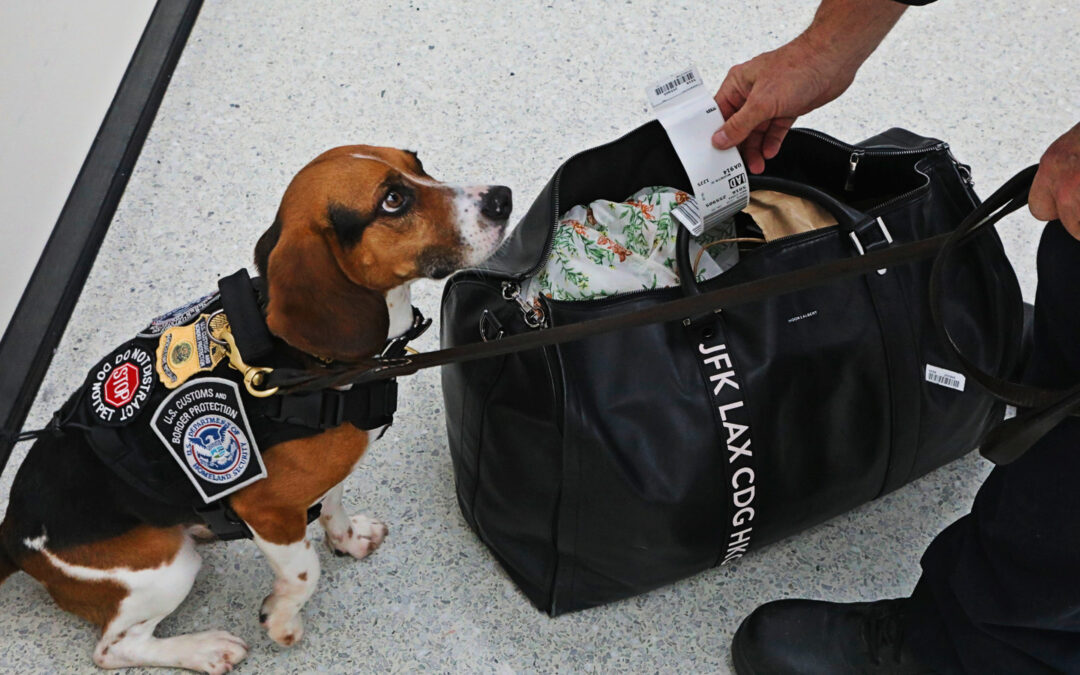
U.S. Customs and Border Protection (CBP) has recently publicized several screening incidents at Philadelphia International Airport (PHL). In late July, CBP revoked a traveler’s Global Entry and confiscated his $21,000 in unreported cash. Months before that, CBP’s K9 Nitro also identified a hidden bulk of over $44,000 in cash in a man’s pockets and carry-on bags.
On Monday, Nitro uncovered yet another attempt by travelers to sneak past security. The CBP detector dog was alerted to a couple who pretended they were not traveling together to the Dominican Republic. Here’s how Nitro busted their flimsy cover story, resulting in a very expensive mistake.
CBP Detector Dog Leads To Confiscation Of Couple’s $19,000 At Philadelphia Airport

On Monday, August 31, CBP officers confiscated a couple’s $19,000 in unreported cash at Philadelphia International Airport. Nitro, a 3-year-old male chocolate Labrador Retriever trained to sniff out bulk currency, was alerted to two passengers boarding a flight to Santo Domingo, Dominican Republic. The couple, a 63-year-old woman and 79-year-old man, initially claimed they were not traveling together despite matching luggage.
|
U.S. Customs And Border Protection’s Currency Reporting Rules For International Arrivals/Departures |
|
|
$10,000 or below |
Clear to fly; perfectly legal without filing any paperwork |
|
Exceeding $10,000 |
Mandatory declaration via FinCEN Form 105; failure to do so can lead to seizure |
When asked how much currency they had with them, the woman declared $9,000 while the man declared $5,000. However, during secondary inspection, officers found a total of $19,681 in the couple’s possession.
They later admitted to traveling together as well. In the end, they were released without charges. CBP only gave back $681 to the couple for “humanitarian purposes” and seized the remaining $19,000.
CBP Warns Travelers Against “Structuring” Currency
In CBP’s official media release for the incident, Elliott N. Ortiz, the Acting Area Port Director for the CBP Area Port of Philadelphia, warned travelers against “structuring” their currency or breaking up a large amount of cash into smaller sums, especially when traveling in pairs or groups.
“This couple attempted to evade federal currency reporting laws by structuring their currency and claiming to be traveling separately, but a keen canine and observant officers easily detected the currency and broke their story,” Ortiz said. “Customs and Border Protection urges travelers to truthfully report all currency they possess to a CBP officer during inspection or face severe consequences as these travelers learned.”
In 2025, CBP confiscated an average of $180,000 in illicit or undeclared currency per day. While there is no maximum legal limit on the amount of cash or monetary instruments travelers can bring into or take out of the U.S., amounts over $10,000 must be reported.
Failure to do so can lead to immediate currency seizure, severe financial fines, and criminal prosecution. The $10,000 threshold is also cumulative rather than individual for those traveling in pairs or groups, which many get confused about.
CBP’s Currency Reporting Rule For Couples And Groups Traveling Together

For couples, families, and groups traveling together, CBP applies the $10,000 currency-reporting threshold to the combined total of the entire group, not individually. This rule also applies not only to cash but also to a wide range of monetary instruments:
- U.S. or foreign coins and currency
- Traveler’s checks, money orders, and cashier’s checks
- Promissory notes and securities or stocks in bearer form
CBP strictly enforces its currency rules to combat international money laundering, drug trafficking, and terrorist financing. Bulk cash raises potential red flags, especially when concealed or not properly declared.
CBP’s cash reporting requirement does not apply to domestic air travel in the U.S, but carrying large sums (like $10,000+) may still prompt the Transportation Security Administration (TSA) to notify law enforcement if they suspect criminal activity. If they are called, and you cannot immediately prove the cash came from a legitimate source, they may attempt to temporarily seize it under civil asset forfeiture laws.
The couple at Philadelphia International Airport could have simply gone on their journey with their cash had they reported it. Unfortunately, despite these crackdowns, many innocent travelers still fail to report large amounts of cash for various reasons, stemming from various misconceptions.
Why Travelers Generally Fail To Declare Currency Over $10,000 To CBP

Aside from the group travel confusion, many travelers often miscount their money and forget about small amounts of cash, loose bills, or spare change, which all count toward the $10,000 threshold for declaration. Additionally, passengers are often more familiar with declaring items upon arrival, forgetting that they must still declare large amounts of cash when departing the U.S.
Furthermore, some assume that the $10,000 threshold for reporting is a legal limit. Some worry that even if they declare a large amount of currency, CBP might still end up flagging it as suspicious and confiscating it.
To be clear, when reporting over $10,000, there are no taxes, duties, or fees owed to CBP. Fortunately, all of these anxieties can be completely avoided by knowing how to properly file your FinCEN Form 105 and what to expect after.
How To Properly Report Currency Over $10,000 To CBP
CBP recommends filing your FinCEN Form 105 electronically via the website to report currency over $10,000 when entering or leaving the U.S. While it is the most straightforward approach, you can also print and fill out the FinCEN Form 105 before your trip and present it to a CBP officer, or obtain and complete the form before departing the U.S. or right upon arrival.
However, there are several risks travelers must know about for each option, which could make a simple process stressful:
|
Filing Option |
Risk |
|
Electronically |
– You must arrive at a U.S. port of entry or departure within 72 hours of submission. – If your travel gets delayed past that window, you have to submit a new form. |
|
Printing and filling out the form before heading to the airport |
– Some travelers misunderstand or forget when and how to present the filled-out form once they are at the airport, probably due to long lines and rushing. – If agents find the cash and the paper form during a search past the primary checkpoint, pulling out the paper will not save you from a failure-to-declare violation. |
|
Filling out form at the airport |
– Filling out a complex legal form under pressure in a busy airport terminal increases the risk of making errors, such as missing a field or miscalculating the total amount in your possession. – Mistakes, false information, and omissions carry the same severe legal penalties as failing to file at all. |
All travelers who have a currency declaration should expect to be redirected to a separate area to complete the process. CBP officers routinely do this as part of their standard administrative procedure. It is not an accusation of wrongdoing. Going there simply gives you and the officer a secure place to inspect the currency, do a proper count, and ask you about the source of the funds and its intended purpose.
TheTravel reached out to CBP for more information about reporting currency over $10,000, as well as their recommendations for those traveling in pairs or groups.

Recent Comments