
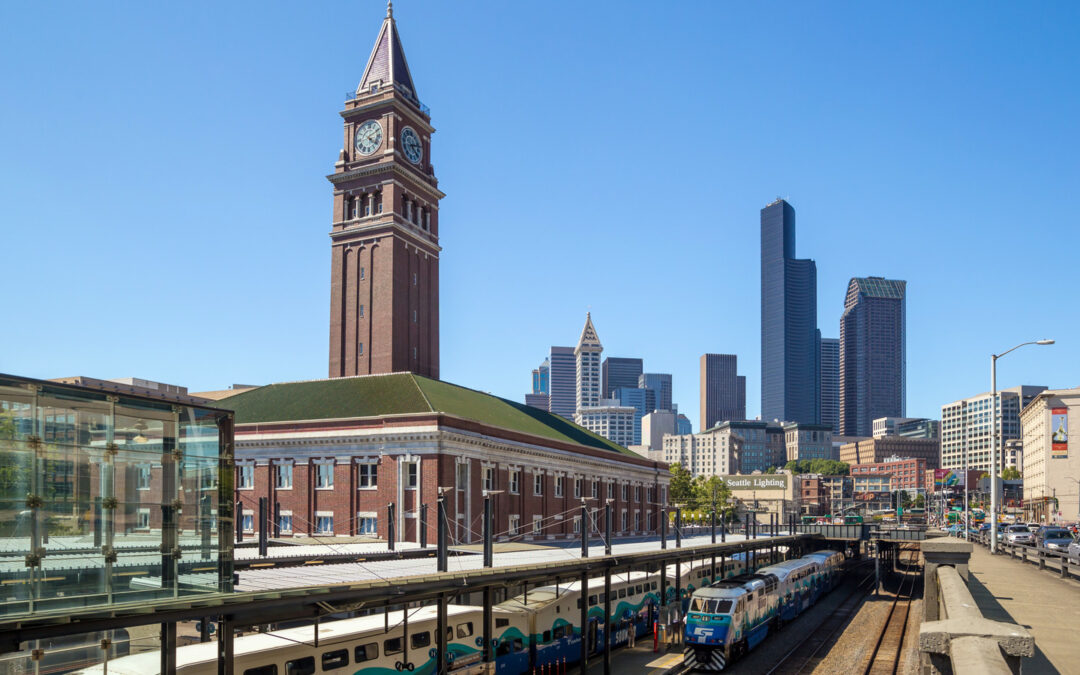
Cincinnati Union Terminal and Los Angeles’ Union Station are among America’s most impressive Amtrak stations, often celebrated for their grand architecture and historical significance. Sure, they live up to the hype, but others are just as deserving, a perfect example being King Street Station, Washington.
This century-old terminal nestled in the heart of downtown Seattle may be the West Coast’s most beautiful Amtrak station, yet it remains one of the most overlooked. Despite its rich design, defined by its Venetian-style clock tower, hand-painted ceilings, marble accents, and Renaissance-inspired interiors, King Street Station lived much of the 20th century in quiet decline. At one point, its grandeur was hidden beneath fluorescent lights and drop ceilings, while its once-busy restaurants and shops closed down to cut costs.
For decades, it was functional but forgotten, until a multi-million-dollar renovation brought it back to life, which is one of the things worth knowing about this Seattle Amtrak station. Today, this rail station has been restored, serving as both a gateway to the Pacific Northwest and a glowing example of sustainable historic preservation. Let’s explore the elegance, history, and transformation of Seattle’s King Street Station, one of America’s most overlooked architectural gems.
History Of The King Street Station, The Most Beautiful Amtrak Station On The West Coast
In the heart of Seattle’s bustling downtown, just steps from the stadiums and waterfront, is King Street Station, a beautiful architectural masterpiece that millions of travelers rely on, yet easily overlook. Completed in 1906, King Street Station is a landmark and a remnant of a grand era in American rail travel when train stations were designed to be functional and breathtaking.
The station was designed by Reed and Stem (present-day WASA Studio), a nationally acclaimed firm responsible for co-designing New York’s Grand Central Terminal. Their goal for Seattle’s terminal was to bring the elegance of Italian Renaissance Revival architecture to the Pacific Northwest. They succeeded, and the result was an iconic building with European influences such as regal symmetry and ornate details, rooted in Seattle’s emerging identity as a major port city.

The station’s crown jewel is its 245-foot red brick clock tower, featuring an arched belfry and clock faces on all four sides, modeled after St. Mark’s Campanile in Venice. Installed in 1906, its four glowing clock faces once kept time for a city on the rise and were wound by hand for decades. Even today, the tower stands as one of Seattle’s most recognizable silhouettes.
At its peak, King Street Station served as a bustling entry point for immigrants, entrepreneurs, and vacationers. It was a key terminal for the Great Northern and Northern Pacific Railways, linking Seattle with destinations across the country. Today, in a city better known for innovation, King Street Station remains one of the most beautiful and historically significant terminals on the West Coast.
King Street Station Faded Into Obscurity
Following the end of World War II in 1945 and as America entered the mid-20th century, the golden age of rail travel gave way to the dominance of cars and airplanes. This reshaped the transportation landscape as highways expanded and airlines grew more accessible, leading to a decline in rail travel throughout the 1950s and 1960s.
For Seattle’s once-iconic King Street Station, this shift marked the beginning of a downward spiral of cost-cutting and neglect. By the early 1960s, declining revenues and shrinking ridership forced station managers, who were then under the control of the Great Northern Railway and Northern Pacific Railway, to cut costs. In an effort to modernize the station and reduce maintenance expenses, much of its historic beauty was obscured.
Key Details About King Street Station
|
Opened |
May 10, 1906, and is listed on the U.S. National Register of Historic Places |
|
Renovated And Restored |
Between 2008 and 2013, the project aimed to restore its grandeur and historical significance |
|
Total Area |
Approximately 62,400 square feet (main station) There’s also a 12-story clock tower covering roughly 6,400 square feet |
|
Serves As A Gateway For |
Over 2.7 million travelers annually |
By the 1970s, most of the railroads were struggling, and in the following year, Amtrak was formed to take over intercity passenger rail service, including King Street Station. While Amtrak kept the station operational, little was done to restore or even maintain its original charm. Meanwhile, the once-vibrant public amenities, including a restaurant, lunch counter, and gift shop, began closing one by one, leading to the installation of a vending machine.
King Street Station continued serving Amtrak routes, such as the Coast Starlight, Empire Builder, Cascades, and regional commuter lines, while its cultural presence diminished. The grand building became utilitarian and a pass-through space with little celebration of its former glory. Many Seattle residents, especially those born after its heyday, had no idea what architectural beauty lay beneath the station’s dated surfaces.
Renovation Brought The Underrated King Street Station Back To Life

By the early 2000s, King Street Station had become a shadow of its former self despite being one of Seattle’s most historic buildings. Fortunately, the City of Seattle saw its potential. In partnership with architects, historians, and sustainability experts, the city launched an ambitious $55 million renovation project to bring the station back to life. The restoration began in the mid-2000s and culminated in 2013, and other Amtrak stations in the U.S. are also set for major upgrades.
Crews removed the drop ceilings that had buried the ornate plasterwork since the 1960s, revealing the original coffered ceiling with its floral medallions and rich patterns. In 1965, a major “remodel” concealed the station’s original hand-plastered ceilings with acoustic tile drop ceilings. The decorative light fixtures were also removed, and the elegant skylights were sealed off, plunging the once-grand waiting room into a fluorescent-lit gloom.
Additionally, the original terrazzo and mosaic floors were buried beneath industrial-grade carpet, stripping away yet another layer of beauty in favor of easy maintenance. Historic skylights were reopened to allow daylight to flood the space once more, and original marble wainscoting, terrazzo floors, and woodwork were cleaned, polished, and restored.

The station’s iconic clock tower, modeled after Venice’s St. Mark’s Campanile was also brought back to full functionality. Its long-dormant clock mechanisms were repaired, and the tower was stabilized and refurbished, once again becoming a reliable and visible timekeeper for the city. The renovated King Street Station earned LEED Platinum certification, making it a national model for sustainable historic preservation. The building was upgraded with solar panels, a geothermal heating and cooling system, energy-efficient lighting, and a rainwater harvesting system for non-potable uses. Every element was designed to honor the past while preparing the station for a more sustainable future.
Today, King Street Station serves as a vital hub for Amtrak’s Cascades, Coast Starlight, and Empire Builder lines, connecting Seattle to Portland, Los Angeles, Chicago, and Vancouver, BC. It also integrates with Sound Transit’s Sounder commuter rail, giving local travelers direct access to Tacoma, Everett, and other regional destinations. King Street Station also features facilities and amenities.
Amenities At King Street Station Include:
- Vending machines
- Bike parking
- Luggage storage
- ATM
- Restrooms
- Ticketing kiosks
Once forgotten and neglected, Seattle’s King Street Station has reemerged as one of the most beautiful and historically significant train stations on the West Coast. Its $56 million restoration revived its original architectural splendor and transformed it into a sustainable, modern-day transit hub.

Recent Comments